

I can remember times when I felt on fire with my writing—where I was in “the zone” or experiencing such a strong “flow state” that I had to remind myself to take breaks, eat, or set timers so I wouldn’t miss a meeting. I felt deeply connected to the work even when a task was difficult, like revising or tracking down a particular source. I couldn’t always see the whole shape of what I was creating, but I trusted the process and knew something was coming together. These were the seasons when I fully embraced calling myself a writer not just because I was writing, but because I was honoring my commitments to the work and the communities I care deeply about.
If I had to offer a song to name this season, I’d choose Yasiin Bey’s “Casa Bey,” wherein, in one line, he captures this feeling:
You know you can’t stop my go
You can’t stop my go
Born to be who I am
Reflecting on those seasons of creative momentum, I often ask myself what they had in common? It wasn’t that writing was completely effortless—it rarely is—but I felt supported. Whether it was a colleague or friend offering feedback, my mom (ever the patient reader and grammar stickler), or a writing group cheering me on, I knew I wasn’t alone. It’s easy to romanticize the idea of a flow state as self-sustaining, but in my experience, that hasn’t been the case. When interruptions inevitably came, the key to regaining momentum was having a network of support.
But not all seasons are seasons of growth. Sometimes, my writing felt stagnant and frustrating when ideas were there but felt impossible to shape into something coherent. These periods often stemmed from one of two challenges. Either I lacked support—no one checking in, offering feedback, or holding me accountable—or I was deeply entrenched in caregiving responsibilities. During those times, my previous writing routines were impossible to maintain. Travel, my parent’s needs, and my kids’ schedules left me little time, energy, or mental bandwidth for creative work. And yet, the tenure clock didn’t stop.
Looking back, I wish I had given myself permission to pause without guilt and to acknowledge that sometimes you simply can’t keep pushing forward. I also wish I had learned to better advocate for myself as a caregiver and academic. (Dr. Katherine Lee has a great podcast series on this topic if you are navigating caregiving and a faculty role.) How might better advocacy have changed my writing? Instead of often struggling in silence, I would have asked for the assistance I needed. Or when I did ask for help and was met with indifference or dismissal, maybe I would have found alternative ways to build the support I needed—through different institutional channels or professional networks.
If I had to name these difficult seasons, I’d turn to BTS’s song “Lost,” with a line I often repeated to myself as reassurance that even in moments of uncertainty, there could still be a path forward:
But I’m still believing it,
although it’s hard to believe it,
that to lose my way,
is the way to find that way. (BTS, Translation by doolset lyrics, 2018)
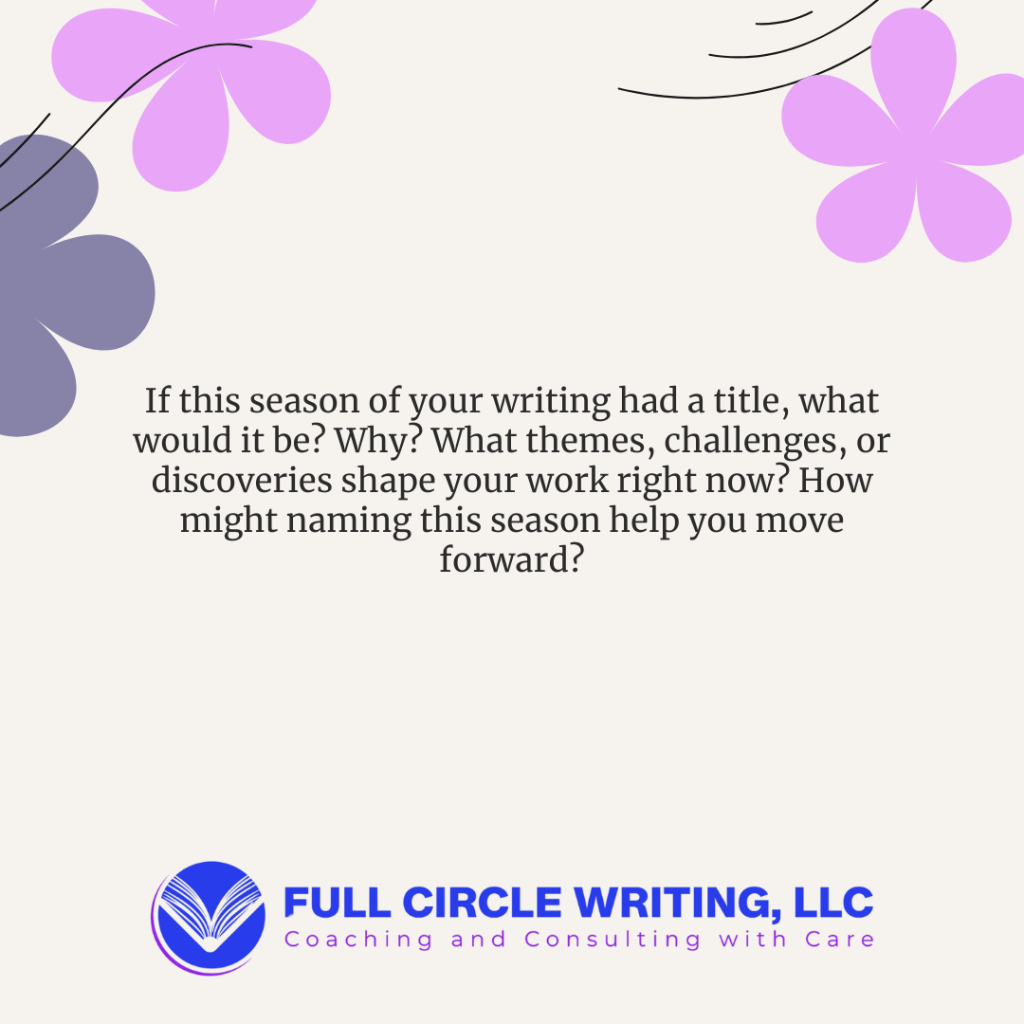
In my newsletter this week, I shared a writing prompt inviting readers to name the writing season they’re currently in. I’m sharing it here, too, because whether you’re in a flow state or simply glancing longingly at your journal while tending to other responsibilities, there is power in naming where you are and what you need. Many of us are pulled in multiple directions, but pausing and reflecting can offer clarity.
Thinking about past writing seasons of flow and connection makes me grateful and reminds me of what I need as a writer: accountability, community, and feedback. Reflecting on the more challenging seasons helps me recognize what I lacked and the importance of integrating those practices during difficult times now: self-care, support in caregiving, and an adjusted pace for my work.
So, what season are you in with your writing? I invite you to take a moment to reflect and perhaps even chart a path forward—or celebrate what you are already achieving. I love music, so my immediate go-to is to think of a song or lyric to caption the season (as you can tell from above!). Maybe it’s a song, a poem, or a quote from your favorite author.
If you’re looking for support in your writing, make sure you’re subscribed to my newsletter. I have summer writing camps coming up, and I also offer one-on-one writing coaching and developmental editing. What kind of support would be most helpful to you?
 Full Circle Writing, LLC
Leave a comment