
Continuing with my theme of engaging in practices that offer hope, I have a short blog post this week about a practice I sincerely appreciate—one that isn’t new but remains invaluable.
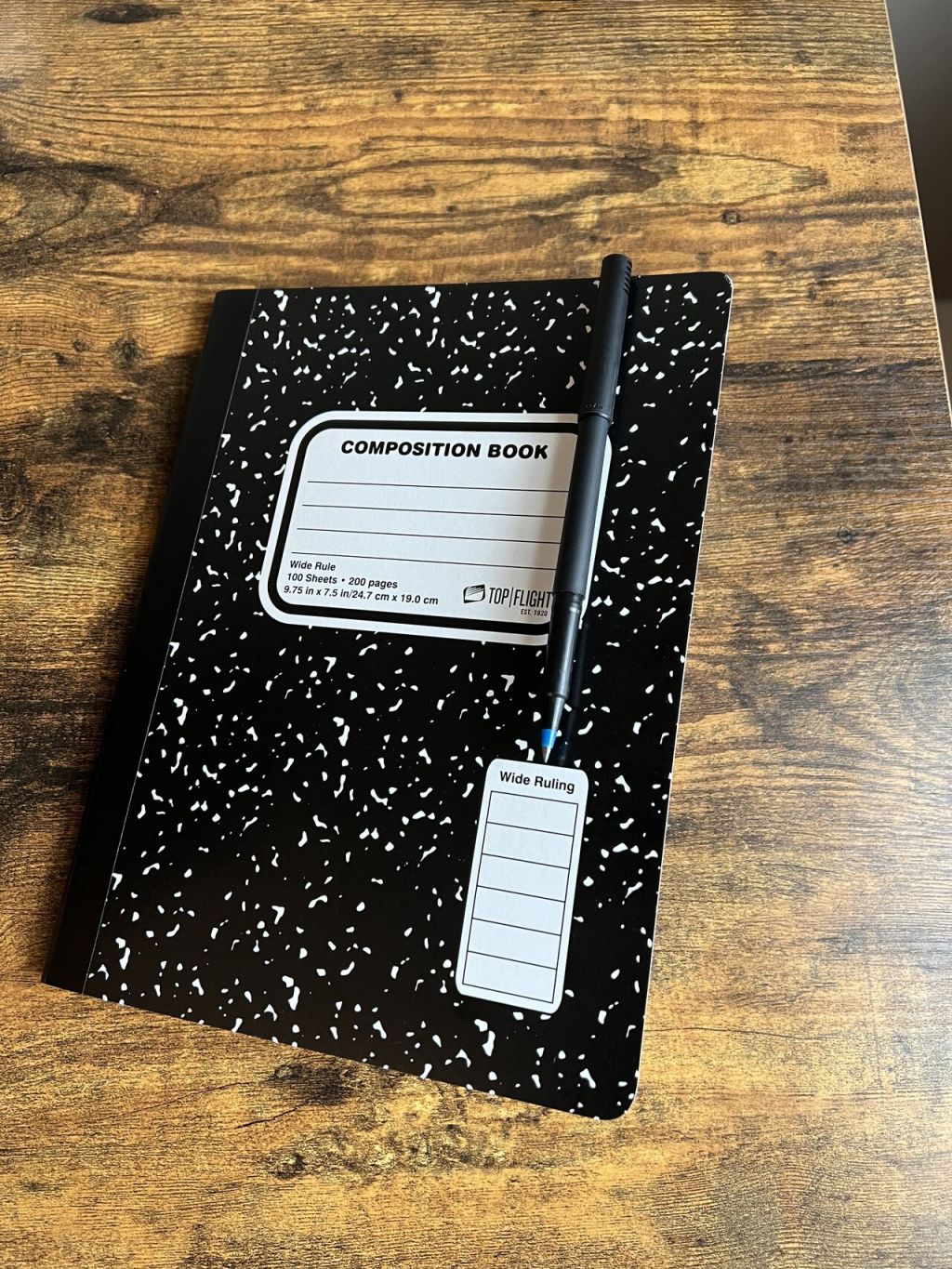
I pulled out one of my favorite notebooks this week—an old-school black-and-white composition book. The first time I used one for journaling was in 4th or 5th grade when a teacher had us respond to daily writing prompts. Every morning, she would write a prompt on the blackboard, and we’d have fifteen minutes to write a response. I remember the teacher checking that we had written something, but these entries weren’t graded or scrutinized. They were simply a space for us to write.
The prompts ranged from playful hypotheticals—What would you do if you won the lottery?—to reflections on our favorite books. Sometimes, they tied into a reading or class activity, but more often than not, they simply invited us to think and be ourselves.
I loved everything about these notebooks and this practice—the way the pages crinkled with use, how the notebook swelled as I filled it, and most of all, the ability to see myself on the page. It was a space just for me—no grades, no performance, just writing. I credit this exercise (and my grandma, who often played school with me) as an early influence that led me toward writing as a career. Even now, I find myself returning to composition books when I need space, freedom, and clarity from seeing my thoughts in ink.
I carved out a morning just to write in my composition book this week. It took effort to protect that time, and some items on my to-do list had to wait. But it was absolutely worth it—pouring my thoughts onto the pages unrestricted. Some of what I wrote may never leave that notebook, and that’s okay.
I’m working on my first offering for writers this spring—one designed to help those who want to recommit to their writing and nurture their work and themselves as writers. Journaling will be a key part of this process, offering a space to reflect, explore, and build a writing practice without pressure.
I’ll share more details about this offering on my website and in my newsletter mid-February. If you’re looking for ways to infuse care into your writing process, I encourage you to check it out! In the meantime, here are two writing prompts I often turn to when thinking about how to care for myself as a writer:
- What does it mean to care for myself as a writer?
- On a good day, I can name the basics I need: space, time, writing tools, art, and books for inspiration. But when sitting at my desk (or parked in the school pickup line) doesn’t spark inspiration, how can I still care for myself as a writer–recognizing that many small actions and steps also count as writing?
- How can I gain clarity about what I need?
- It’s easy to push our own needs to the bottom of the list. I’m learning that rather than a fixed checklist, I need a fluid approach—one that allows me to make space for the support and activities that nourish my writing.
- It’s easy to push our own needs to the bottom of the list. I’m learning that rather than a fixed checklist, I need a fluid approach—one that allows me to make space for the support and activities that nourish my writing.
If you try these prompts, I’d love to hear how they work for you. And if you’ve ever had a beloved composition book or a journaling habit, tell me about it—I’d love to hear your story.
 Full Circle Writing, LLC
Leave a comment